|
Diagnosis
Synopsis: Small, slender dolichoderine ant. Petiole bearing a tall dorsal scale with apex narrowed and distinctly curved posteriad. Compound eyes located near longitudinal midpoint of head and touching lateral margins in full-face view. Anterior margin of clypeus projecting forward in a broad convexity. Antennal scapes longer than head length. Dorsum of head, mesosoma, and metasoma exclusive of abdominal tergite 6 devoid of erect setae.
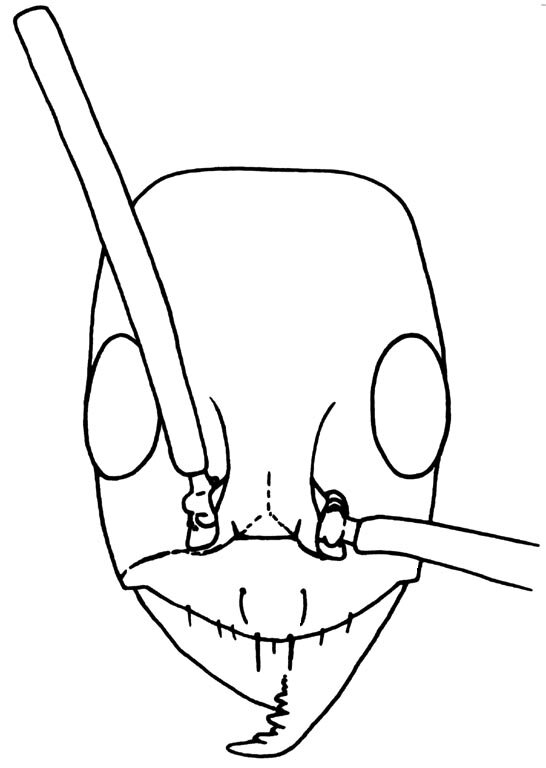
HEAD. In full frontal view longer than broad and quadrate-oval in shape (Fig. 1). Lateral margins convex, posterior margin straight. Compound eyes situated near longitudinal midpoint of head, touching lateral margins, and large in size, with at least 50 ommatidia (>130 in G. pombero). Ocelli absent. Antennae 12-segmented, scapes noticeably longer than head length. Clypeus large and entire, without a median notch or concavity, and projecting forward with a broad, convex anterior margin. Hypostoma with a strong medial notch. Psammophore absent.
Figure 1. Gracilidris pombero head in full-face view
(click to enlarge). Specimen from Paraguay.
MOUTHPARTS. Palp formula 6:4. Maxillary palp segments generalized and subequal in length, except for a short proximal segment. Mandibles triangular with dentition as follows: strong apical tooth, a smaller subapical tooth, and a series of 8–12 small teeth or denticles on masticatory margin. Basal angle indistinct and often bearing several denticles.
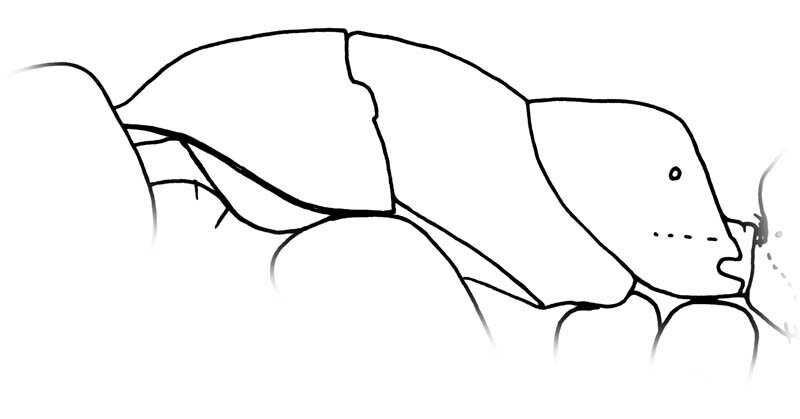
MESOSOMA. Pronotum and mesonotum freely articulating, not fused, and in lateral view forming a single continuous convexity (Fig. 2). Pronotum rounded laterally. Propodeum depressed below the level of promesonotum. Dorsal and declivitous faces of propodeum subequal in length and meeting in an indistinct convexity. Propodeal spiracle located postero-laterally, at about 2/3 height of declivitous face.
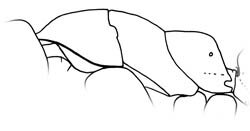
Figure 2. Gracilidris pombero mesosoma in lateral view
(click to enlarge). Specimen from Paraguay.
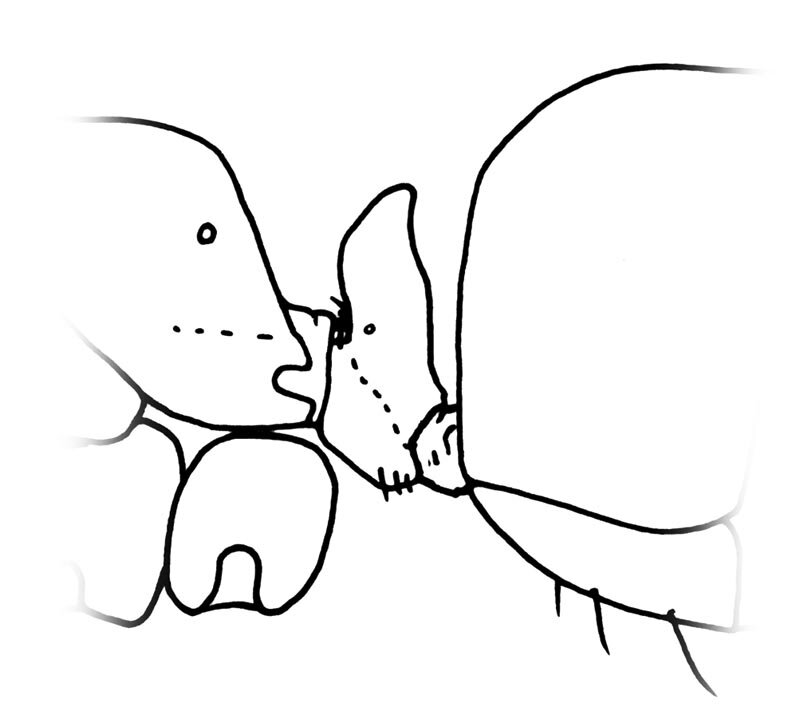
PETIOLE (abdominal segment 2). With a distinct dorsal scale that is taller than broad, inclined anteriorly, and achieving height of propodeal spiracle. Apex of scale narrowed into a point and distinctly curved posteriad, so that in lateral view anterior face of apical third of scale is convex and posterior face is slightly concave (Fig 3). Venter of petiole with a weakly developed lobe.
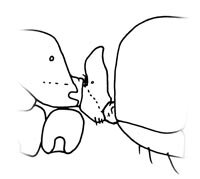
Figure 3. Gracilidris pombero propdeum, petiole, and first gastric
segment in lateral view (click to enlarge). Specimen from Paraguay.
GASTER (abdominal segments 3–7). Gaster in dorsal view with four visible terga. Abdominal tergite 7 small, concealed under tergite 6, and oriented ventrally. Gaster in posterior view roughly triangular and slightly compressed laterally. First gastral segment (abdominal segment 3) with anterior tergosternal suture extending laterally from helcium. Ultimate abdominal sternite (abdominal sternite 7) folded medially in shape of a longitudinal keel.
GENERAL. Worker morphology generalized, somewhat elongate. Worker caste monomorphic. Integument thin and covered in a dense, fine pubescence. Proventriculus small, weakly developed, and unsclerotized, without phragma or visible pile, and with a dome-shaped cupola divided into 4 quadrats. Proventricular cupola only partly obscuring the bulb in lateral view, and about as wide or only slightly wider than the bulb.
reference:
- Wild, A. L., and F. Cuezzo. 2006. Rediscovery of a fossil dolichoderine ant lineage (Hymenoptera: Formicidae: Dolichoderinae) and a description of a new genus from South America. Zootaxa 1142: 57-68.
|